
fw.relate
Use fw.relate when a question spans two tables, or a table and itself: are the keys in one export found in the other, how many rows each key has on each side, and whether a shared detail agrees. Every answer is a state (all, some, none, or a cardinality such as n:1) with its counts alongside.
relate never joins the tables, so it cannot fan out a large table. It does not discover join keys, compare values after a transformation (derive the column first), or place attributes across a join; use grain on a joined frame for that.
Jump to the worked example or the argument reference.
Function reference
Section titled “Function reference”fw.relate( left, right=None, *, on, compare=None, match='typed', dropna=True, scopes=None, missing=None, table_ids=None, limits=None, progress=None, cancel=None, timeout=None, safe_errors=None,)This page describes Fieldwork 0.3.2. Import the package with import fieldwork as fw. View the documented source.
Arguments
Section titled “Arguments”| Argument | Type / default | Effect |
|---|---|---|
left |
pandas.DataFrame; required | The left table. Analysis preserves its values and row order; duplicate column labels are rejected. |
right |
pandas.DataFrame or None; None |
The right table. None relates left to itself: the left columns of on are references and the right columns are the key each row is referenced by. |
on |
mapping; required | Nonempty key pairs, left column to right column, such as {"member_id": "member_id"}. Several pairs form a composite key. Rows missing any key column are excluded and counted per side as incomplete_key. |
compare |
mapping or None; None |
Attribute pairs, left column to right column, tested for agreement on matched keys. None compares nothing. |
match |
“typed” or “text”; 'typed' |
How values match across tables. "typed" keeps booleans, numbers, strings and temporal kinds apart and matches numbers numerically, so 101 matches 101.0. "text" also matches integer-valued numbers to their decimal text, so 101 matches "101"; "0101" still does not. |
dropna |
bool; True |
True ignores missing compared values. False treats missing as one shared value, so missing on both sides agrees. Keys are never matched on missing values. |
scopes |
pair or None; None |
(left, right) saved row selections, each a Scope of its own table or None for every row. |
missing |
pair or None; None |
(left, right) sentinel mappings, such as ({"member_id": [-1]}, None). Native nulls are always missing. |
table_ids |
pair or None; None |
(left, right) nonempty table identities used in statements and features. None uses ('left', 'right'), or ('table', 'table') for a self-reference. They do not bypass source-fingerprint checks. |
limits |
mapping or None; None |
Output budget (fieldwork.typing.RelateLimits). example_limit (5): source rows saved per finding and side; select and inspect(..., all_matches=True) still recover every matching row. |
progress |
bool or callable; None |
Silent by default; True displays progress, or pass a synchronous ProgressEvent callback. See runtime controls. |
cancel |
CancellationToken or None; None |
Cooperative cancellation token; cancellation raises AnalysisCancelled without returning a partial result. |
timeout |
float or None; None |
Finite nonnegative seconds from call start; None disables the cooperative deadline. A running pandas/NumPy work item must finish before cancellation. |
safe_errors |
bool or None; None |
True raises any other failure as AnalysisError, naming the operation, phase and column without echoing the original message, which can quote cell values. See runtime controls. |
Returns and output choices
Section titled “Returns and output choices”Returns a fieldwork.Result with kind="relation" (schema 2.0). Its source, scope and missing_convention describe the left table; sides["left"] and sides["right"] each record their own source, scope, sentinels, key and compared columns, row accounting (evaluated, incomplete_key, matched, unmatched) and key accounting (distinct, matched, unmatched, repeated).
key_coverage["left_to_right"]and["right_to_left"]: of one side’s distinct complete keys, how many arefoundon the other side. Thestateisall,some,none, oremptywhen that side has no complete key.found_rowsandnot_found_rowscount the rows behind them.relation: the cardinality over matched keys,1:1,1:n(one left row, several right rows),n:1orn:m, withjoined_rows, the size an inner join would have. The type isNonewhen no key matches.agreement: one record per compared pair. A matched key isunavailablewhen a side has no value,ambiguouswhen a side has several, and otherwise agrees or disagrees. Thestatecovers agreeing plus disagreeing keys (emptywhen there are none);ambiguityissomewhen any key is ambiguous. Variation within one table is therefore never reported as disagreement between the tables.reciprocity: for a self-reference, whether resolved referencesa → bare matched by a row with keybthat referencesa. Self-loops are counted inself_referencing_keysand excluded.Nonefor two tables.warnings: aVALUE_KIND_MISMATCHrecord when the value kinds of a key or compared pair do not overlap, so a type mismatch is never reported only as “no key is found”.
Each coverage, relation, agreement and reciprocity record becomes a finding whose structure keeps its state for topology exports. Use plaintext, SVG or HTML for a report, and to_dict() for an archive. recompute(left, right=right) reruns the analysis on both verified sources.
Interpretation and boundaries
Section titled “Interpretation and boundaries”Coverage, relation and agreement count distinct keys, not rows; reciprocity counts distinct resolved references. A finding’s examples and exceptions belong to one side, named by selector["side"]:
| Finding | Examples | Exceptions |
|---|---|---|
| Coverage | rows whose key is found | rows with a complete key that is not found |
| Relation | rows of matched keys repeated on the side | rows of matched keys that occur once there |
| Agreement | rows of agreeing keys | rows of disagreeing keys |
| Reciprocity | rows whose reference is reciprocated | rows whose resolved reference is not |
result.inspect(left, finding, side="right", right=right) returns the right side’s rows, and select builds a Scope of the chosen side’s table. Complete selections and right-side rows need the right frame, since matching needs both tables; both frames are verified against their fingerprints. A self-reference takes no right.
A missing column raises KeyError. An empty on, a column repeated within on or compare, or a per-side argument without two entries raises ValueError; a non-mapping on or compare raises TypeError.
Walkthrough: a tool library’s loans and members
Section titled “Walkthrough: a tool library’s loans and members”A neighborhood tool library keeps two exports: one row per loan, and one row per member with their home branch and a volunteer buddy. Before the coordinator merges them into a newsletter list, they want to know whether every loan belongs to a known member, whether loans are recorded at the member’s home branch, and whether the buddy pairs are mutual.
Download the runnable example. It follows the same steps and saves a figure and the result in your working directory.
Load the two exports
Section titled “Load the two exports”One loan has no member recorded. That missing value makes pandas store the loan table’s member numbers as floats, while the member table keeps integers.
import jsonfrom pathlib import Path
import pandas as pdimport fieldwork as fw
members = pd.DataFrame(    [        (101, "North", 102),        (102, "North", 101),        (103, "South", 104),        (104, "South", None),        (105, "South", 101),    ],    columns=["member_id", "home_branch", "buddy_id"],)loans = pd.DataFrame(    [        ("L1", 101, "drill", "North"),        ("L2", 101, "ladder", "North"),        ("L3", 102, "saw", "South"),        ("L4", 103, "drill", "North"),        ("L5", 103, "sander", "South"),        ("L6", 107, "ladder", "South"),        ("L7", None, "saw", "South"),    ],    columns=["loan", "member_id", "tool", "branch"],)print(loans.to_string(index=False))print("Key types:", loans["member_id"].dtype, "and", members["member_id"].dtype)
loan member_id tool branch L1 101.0 drill North L2 101.0 ladder North L3 102.0 saw South L4 103.0 drill North L5 103.0 sander South L6 107.0 ladder South L7 NaN saw SouthKey types: float64 and int64Relate loans to members
Section titled “Relate loans to members”Name the tables so the statements read naturally. The default typed matching compares numbers numerically, so 101.0 matches 101.
link = fw.relate( loans, members, on={"member_id": "member_id"}, compare={"branch": "home_branch"}, table_ids=("loans", "members"),)for finding in link["findings"]: print(finding["id"], finding["statement"])f0 Some loans.member_id keys are found in members.member_idf1 Some members.member_id keys are found in loans.member_idf2 loans.member_id to members.member_id is n:1 on matched keysf3 loans.branch and members.home_branch agree on some comparable matched keysFind the loans and members that do not connect
Section titled “Find the loans and members that do not connect”Coverage counts distinct member numbers. The loan without a member number is not a key at all; it is counted separately as an incomplete key.
print(link["key_coverage"]["left_to_right"])print(link["sides"]["left"]["rows"])unknown = link.inspect(loans, "f0", exceptions=True)print(unknown.to_string(index=False)){'state': 'some', 'keys': 4, 'found': 3, 'not_found': 1, 'found_rows': 5, 'not_found_rows': 1}{'evaluated': 7, 'incomplete_key': 1, 'matched': 5, 'unmatched': 1}loan member_id tool branch L6 107.0 ladder SouthMember 107 borrowed a ladder but is not in the member export. In the other direction, the exceptions are members on the right side, so pass side="right" and the member frame:
no_loans = link.inspect(loans, "f1", exceptions=True, side="right", right=members)print(no_loans.to_string(index=False)) member_id home_branch buddy_id 104 South NaN 105 South 101.0Members without loans are expected in a lending library; the missing member 107 is the record to follow up.
Read cardinality and agreement separately
Section titled “Read cardinality and agreement separately”Each member number occurs once in the member export and up to twice in the loans, so matched keys are n:1: joining would give one row per matched loan. Agreement then compares each member’s loan branches with their home branch.
print(link["relation"]["type"], "with", link["relation"]["joined_rows"], "joined rows")agreement = link["agreement"][0]for field in ["state", "ambiguity", "agreeing_keys", "disagreeing_keys", "ambiguous_keys"]: print(f"{field}: {agreement[field]}")print(link.inspect(loans, "f3", exceptions=True).to_string(index=False))n:1 with 5 joined rowsstate: someambiguity: someagreeing_keys: 1disagreeing_keys: 1ambiguous_keys: 1loan member_id tool branch L3 102.0 saw SouthMember 101 borrowed only at North, their home branch, and agrees. Member 102 borrowed at South although their home branch is North, and disagrees. Member 103 borrowed at both branches, so the loan table itself has two values for that member: it is ambiguous rather than a disagreement, and it is not counted either way.
Match member numbers that arrive as text
Section titled “Match member numbers that arrive as text”A spreadsheet export often writes member numbers as text. Typed matching never matches numbers to strings, so nothing is found, and the result warns that the key columns hold different kinds of values instead of reporting only missing members.
members_csv = members.astype({"member_id": "string"})typed = fw.relate( loans, members_csv, on={"member_id": "member_id"}, table_ids=("loans", "members"))print(typed["key_coverage"]["left_to_right"]["state"])print(typed["warnings"][0]["code"], typed["warnings"][0]["left_kinds"], typed["warnings"][0]["right_kinds"])as_text = fw.relate( loans, members_csv, on={"member_id": "member_id"}, match="text", table_ids=("loans", "members"),)print(as_text["key_coverage"]["left_to_right"]["state"], as_text["warnings"])noneVALUE_KIND_MISMATCH ['number'] ['string']some []match="text" writes integer-valued numbers as decimal text, so 101.0 matches "101" and coverage is the same as before. Text is still compared exactly: a zero-padded "0101" would not match.
Check that buddy pairs are mutual
Section titled “Check that buddy pairs are mutual”With no right table, relate resolves each member’s buddy_id against the member numbers of the same table. Member 104 has no buddy, so that row has an incomplete reference.
buddies = fw.relate(members, on={"buddy_id": "member_id"})for finding in buddies["findings"]: print(finding["id"], finding["statement"])print(buddies["reciprocity"]["reciprocated"], "of", buddies["reciprocity"]["resolved_references"], "reciprocated")print(buddies.inspect(members, "f3", exceptions=True).to_string(index=False))f0 Every table.buddy_id reference resolves to a table.member_id rowf1 Some table.member_id keys are referenced by table.buddy_idf2 table.buddy_id to table.member_id is n:1 on matched keysf3 Some resolved table.buddy_id references are reciprocated2 of 4 reciprocated member_id home_branch buddy_id 103 South 104.0 105 South 101.0Members 101 and 102 name each other. Member 103 names 104, who has no buddy, and 105 names 101, who is already paired with 102. Those are the two pairs to confirm.
Save the evidence
Section titled “Save the evidence”The figure lists each finding with its counts. The JSON export keeps both sides’ sources, so the analysis can be recomputed once both frames are supplied again.
Path("relate.svg").write_text(fw.render_svg(link), encoding="utf-8")Path("tool-library-relation.json").write_text(json.dumps(link.to_dict()), encoding="utf-8")saved = fw.Result.from_dict(json.loads(Path("tool-library-relation.json").read_text()))again = saved.recompute(loans, right=members)print("Same coverage after recompute:", again["key_coverage"] == link["key_coverage"])Same coverage after recompute: True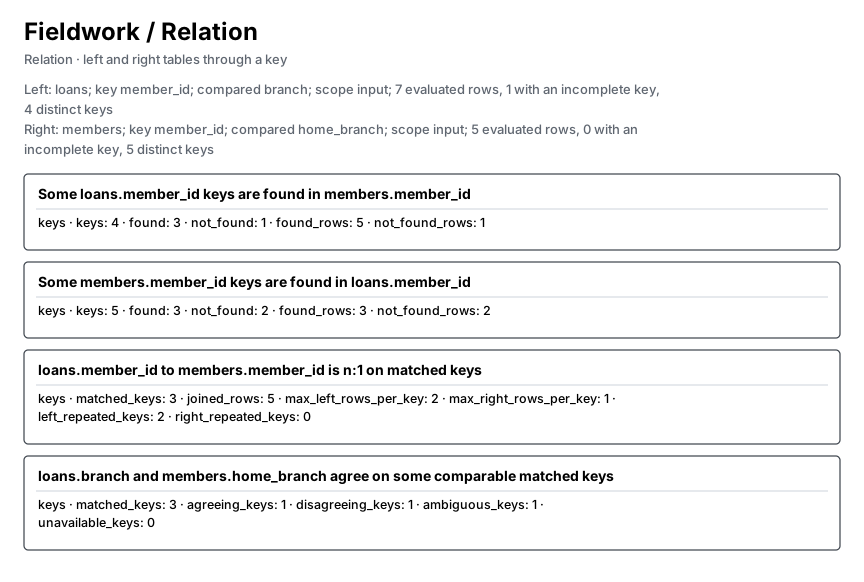
Continue exploring
Section titled “Continue exploring”fw.grain, fw.compare, fw.render_svg. See results and configuration for inspection, selection and serialization contracts.